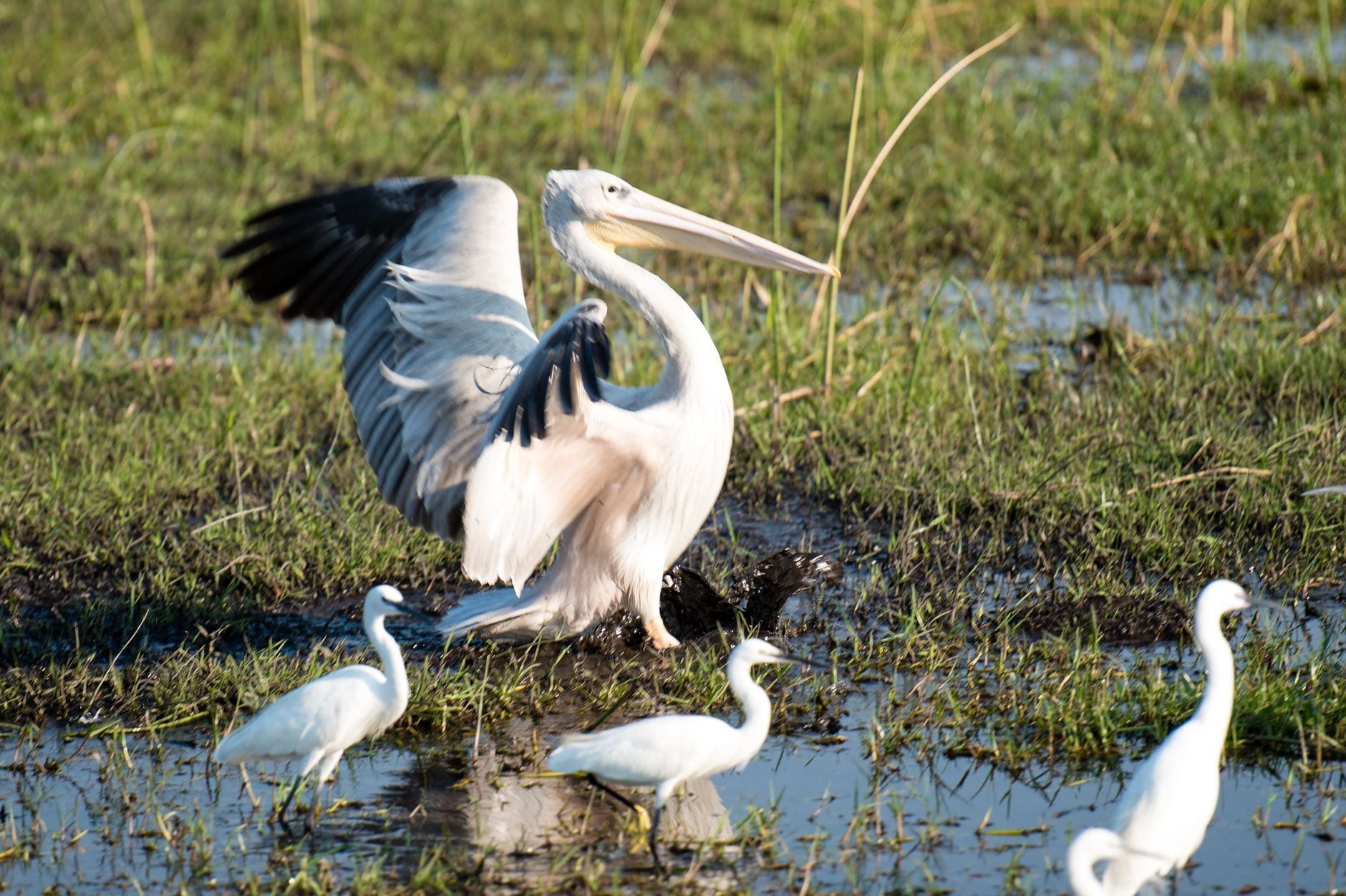
Rivers that never reach the sea have no business producing one of the densest wildlife concentrations in Africa — yet here it is. The Okavango River drains the Angolan highlands and fans out across the Kalahari sands of north-west Botswana, and the animals follow the water. Elephant, buffalo, lion and hippo share these channels with 130 mammal species in total and 482 birds. Our guide to an Okavango Delta safari covers the logistics; this one is about the animals — which ones you'll actually see, and where and when to see them.
What Makes the Okavango Delta a Wildlife Sanctuary
Every year about 11 cubic kilometres of water arrive from Angola, spread across 6,000–15,000 square kilometres of floodplain, and then almost entirely disappear — roughly 97% is lost to evaporation and plant transpiration. That annual soaking and drying is the whole story. It arrives in April, peaks between June and August, and drains as local rains begin in December, so the Delta's wildlife spends the year moving between flooded core and dry fringes, compressed into a mosaic of permanent swamp, seasonal floodplain, riverine forest and mopane woodland. Wetland-adapted species live beside classic dry-country game, which is why you can see a red lechwe and a giraffe in the same afternoon.
The official baseline comes from UNESCO, which inscribed the Delta as a World Heritage Site in 2014: 130 mammal species, 482 birds, 89 fish, 64 reptiles and 1,061 plants. Safari operators round those numbers in their marketing — you'll see bird counts from 400 to 560 quoted — but UNESCO's figure is the verified one. The Delta is also a designated Important Bird Area holding 24 globally threatened species, including six vultures, the wattled crane and the slaty egret, and it sustains robust populations of some of the world's most endangered large mammals: cheetah, both rhino species, African wild dog and lion.
Three animals physically built the place. Termites started it — around 70% of the Delta's islands began as termite mounds that vegetation then colonised. Hippos push through the reeds night after night, keeping channels open, and elephants widen paths into waterways on their daily commute. Remove the hippos and the system silts up: when they were hunted out of the south-west in the twentieth century, vegetation choked the waterways and the flow diverted. They have since returned to that area, and the channels reopened.
Botswana's roughly 130,000 elephants — the largest national population on the continent — have their core area here, and the Delta's protection matters: Moremi Game Reserve covers about 40% of the World Heritage property, with the rest split into community and private concessions where a hunting ban applies. When the rains fall from December, herds spread out onto grazing beyond the Delta's edge; as everything dries, they crowd back to the permanent water, and the viewing compresses with them.
The Big Five in the Delta — and the Truth About Rhino
You can realistically tick four of the Big Five in the Okavango: elephant and buffalo are rated abundant to common, lion and leopard are reliably present across the Delta. Rhino is the honest asterisk, and plenty of safari marketing fudges it. Here's the actual position.
Elephant are the Delta's sure thing — rated abundant — and Botswana's national herd of roughly 130,000 makes encounters near-certain anywhere with permanent water. Dry-season drives along the channels deliver breeding herds crossing shallow lagoons, and you'll hear them splashing before you see them. Buffalo are equally dependable, and the Delta's herds are enormous: the Duba Plains herd runs to around 1,000 animals, and where buffalo go, lion prides follow.
Lion and leopard are both rated "occasional" — which in practice means several good sightings across a three- or four-night stay, not one per drive. Leopard favour the riverine forest and wooded islands, lion work the floodplain edges, and Chief's Island hosts several resident prides. If Big Five photography is the goal, guided safari tours with a dedicated tracker close the gap between "occasional" and "found".
Now the rhino. Botswana's last native black rhino was poached in 1992, and the species was locally extinct by the early 1990s. White rhino were reintroduced first, in the early 2000s, with good success; black rhino followed from 2003, starting from roughly two dozen founder animals relocated from South Africa. Current estimates put the Delta's black rhino population at only around 40 animals, closely guarded against poaching. Both species live year-round on and around Chief's Island in the Moremi area — the strongest odds in the region — but sightings are rated rare to very rare. Plan for four of five, treat the fifth as a gift.
Predators: Lions, Leopards, Wild Dogs and the Rest
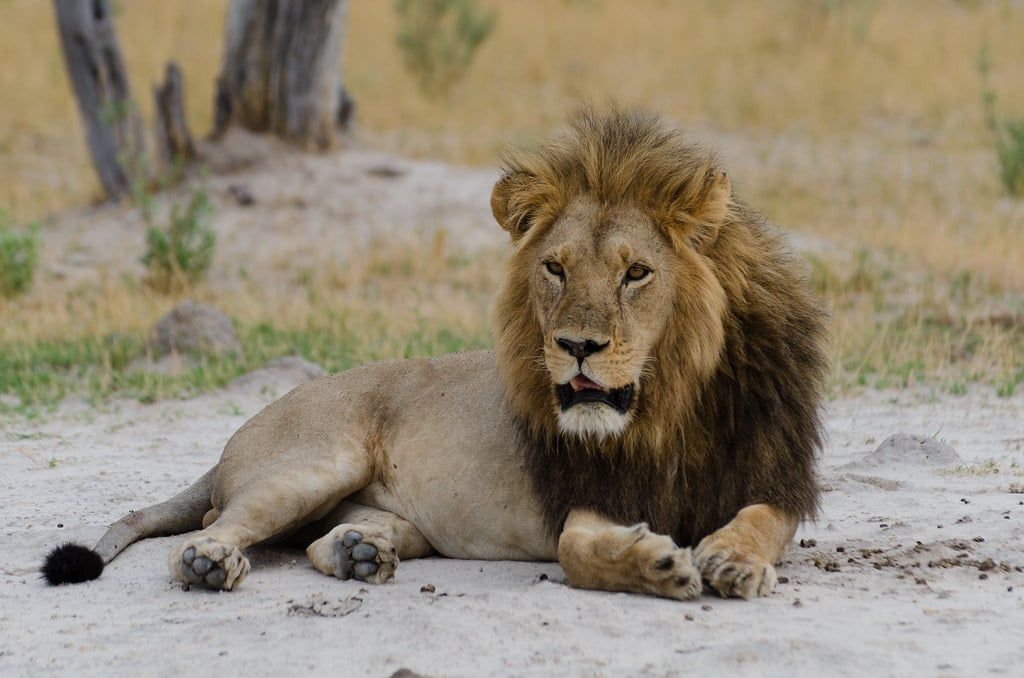
The Delta supports some of Africa's highest predator densities, and its big cats do things cats aren't supposed to do — swim. Set expectations honestly: lion, leopard, hyena and wild dog rate "occasional"; cheetah rates "rare". What you lose in frequency you gain in quality, because Delta predators behave differently from anywhere else.
Lion
Okavango lions are strong swimmers that move between islands and have been recorded hunting in the water — even taking crocodiles. Prides run from three to around thirty members, and several prides hold territory on Chief's Island alone. The signature sighting is buffalo-lion dynamics: at Duba Plains, where the ~1,000-strong buffalo herd lives alongside dedicated prides, the two species shadow each other, and confrontations — buffalo forming defensive circles, lions probing the edges — are among the Delta's most dependable dramatic scenes.
Leopard
Leopards here hunt by ambush from riverine forest and wooded islands, dragging kills into trees above the flood line. They're the Delta's most widespread big cat and the one most likely to appear within sight of camp. The Mombo area on Chief's Island has a particular reputation for them, with sightings possible even from the raised walkways between tents.
African Wild Dog
The Okavango, together with the Linyanti and Chobe systems to the north-east, holds one of the last viable wild dog populations in Africa and some of the continent's richest pack densities. The painted coats sell the photos, but the hunt is the spectacle: packs run prey down in relays, taking turns at the front at full sprint. Packs den around June–July with litters of up to 15 pups, and while the pack is tied to the den, sightings become regular and predictable. For many visitors this is the sighting of the trip.
Cheetah and Spotted Hyena
Cheetah are scarcer here than in open-country parks — rated rare — because much of the Delta is too cluttered for a flat-out sprint. Your chances sit on the open floodplains, where they use what little open ground exists. Spotted hyena are common after dark; their clans hold large territories, and night drives in the private concessions regularly find them on the move.
Wetland Specialists: Hippos, Crocodiles and the Delta's Aquatic Antelope
This is what separates the Okavango from every other major safari destination: half its best wildlife lives in the water, and you watch it from the water. Hippos and crocodiles are rated abundant, and two wetland antelope — red lechwe and sitatunga — are animals most visitors have never heard of until they arrive.
Hippopotamus
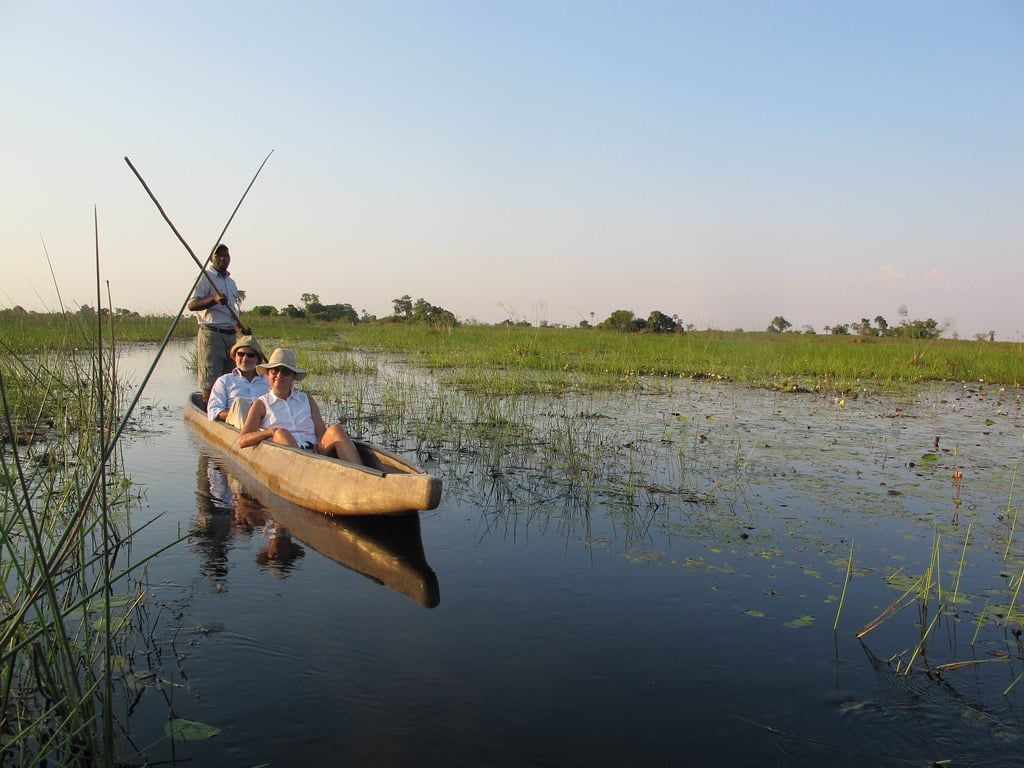
Hippos weigh up to two tonnes and can move at over 30 km/h on land, which is worth remembering when one surfaces beside your mokoro. They are the Delta's ecosystem engineers: their nightly channel-clearing keeps the waterways open, and their twentieth-century extermination from the south-west choked the flow until they returned. Days are spent submerged in lagoons in pods of a dozen or more, and any boat trip runs a soundtrack of grunts, bellows and the occasional wall-shaking yawn.
Nile Crocodile
Roughly 2,600 crocodiles were counted in the Delta's Panhandle, about a quarter of them adults — big specimens past four metres sunning on sandbanks with their jaws open. They're sit-and-wait predators, taking fish primarily and anything drinking at the water's edge opportunistically. Breeding is brutal arithmetic: only around 2% of crocodile eggs hatch into surviving young, so females guard nests ferociously. Keep your hands inside the boat.
Red Lechwe and Sitatunga
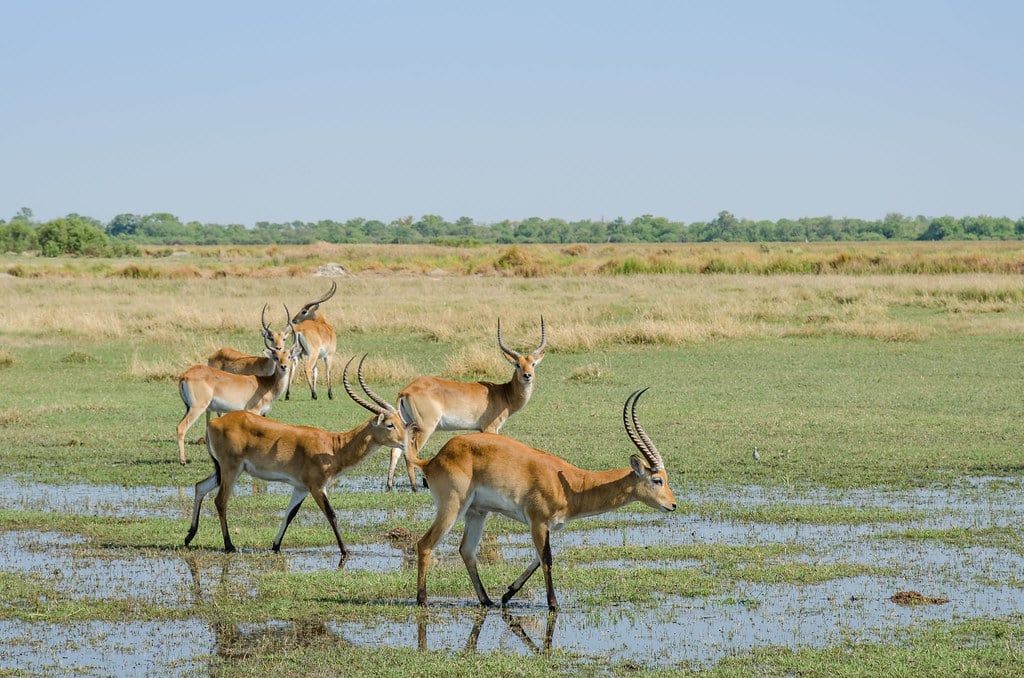
Red lechwe are built for the floodplain: sloping backs, powerful hindquarters, and a bounding gait that lets them leap through shallow water faster than a lion can run through it. When chased, they head for deeper water — a predator that follows usually regrets it. The Delta holds Africa's largest lechwe population, and herds of hundreds graze the wet fringes at dawn.
Sitatunga are the marquee rarity. Their long, splayed hooves spread the weight for walking on submerged vegetation, and their escape trick is to sink — submerging with only the nostrils above the surface. They're shy, restricted to the permanent swamp, and your odds are best in the western concessions of Jao and Jedibe, ideally from a mokoro safari moving quietly through papyrus.
Birdlife: 480+ Species and How to Find the Specials
Birders get more than they expect in the Delta: 482 species across a compact area, an Important Bird Area designation, and 24 globally threatened species on the list. Even committed non-birders leave converted, because the birds here are impossible to ignore — fish eagles calling from dead trees, jacanas walking on lily pads, skimmers cutting the channels at dusk.
Waterbirds of the Channels and Lagoons
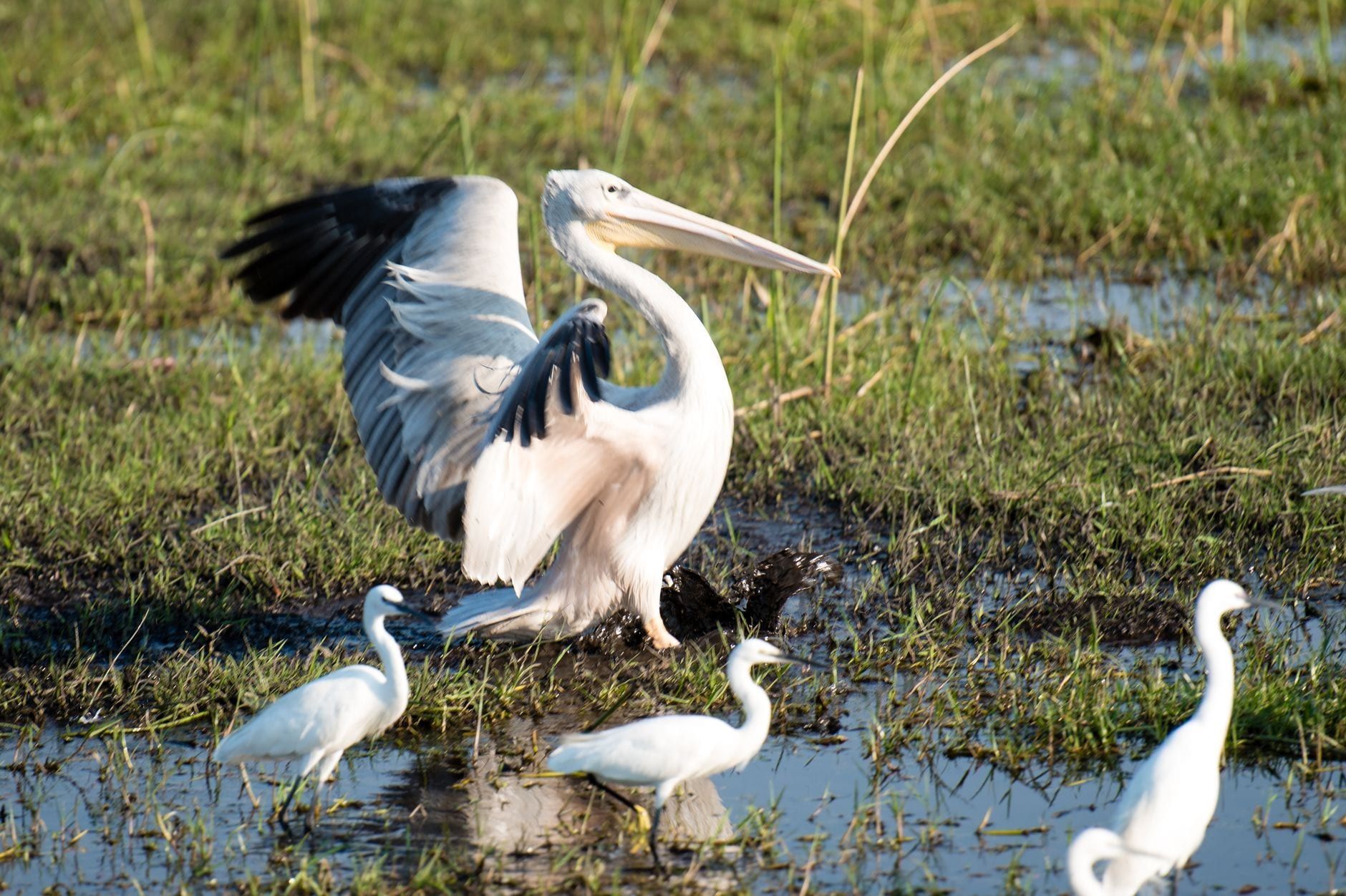
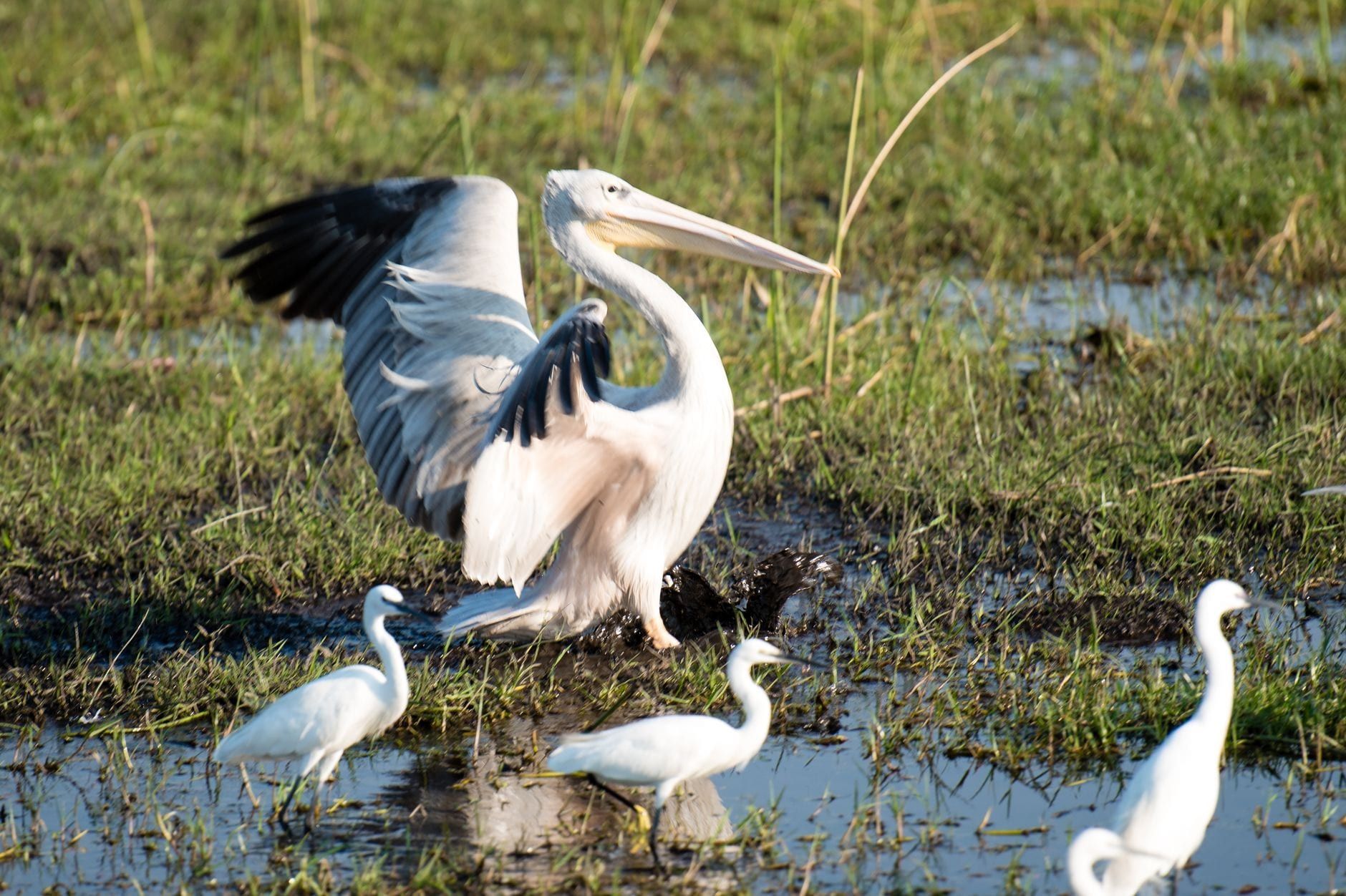
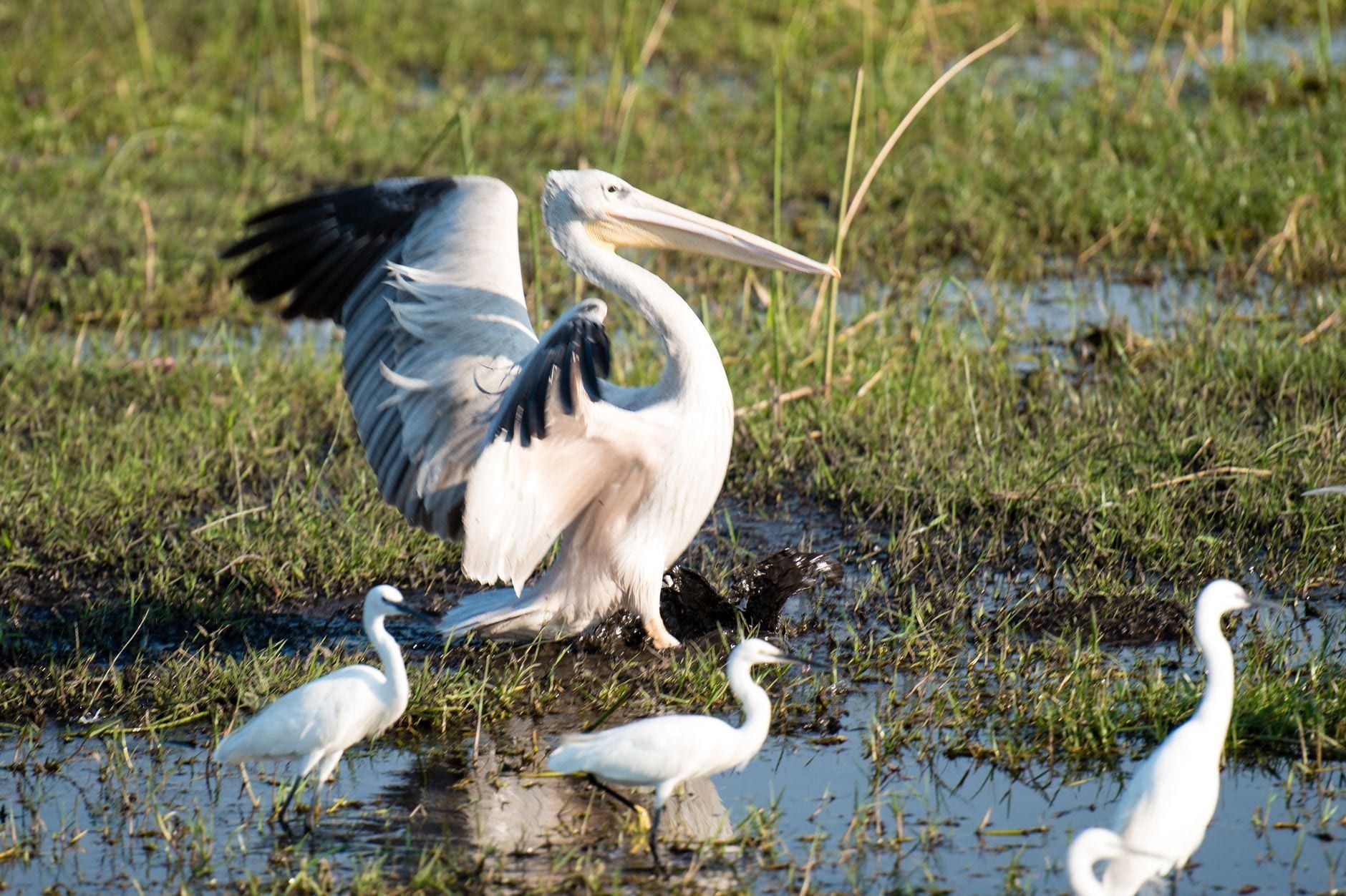
African jacanas — the "lily-trotters" — stroll across floating vegetation on absurdly long toes, and their tiny relative the African pygmy-goose, Africa's smallest duck, hides among the water-lilies. Saddle-billed storks stalk the shallows on metre-tall legs, with herons and egrets in every niche behind them. These residents are present year-round and need no particular season or strategy.
Raptors and the Nocturnal Prize
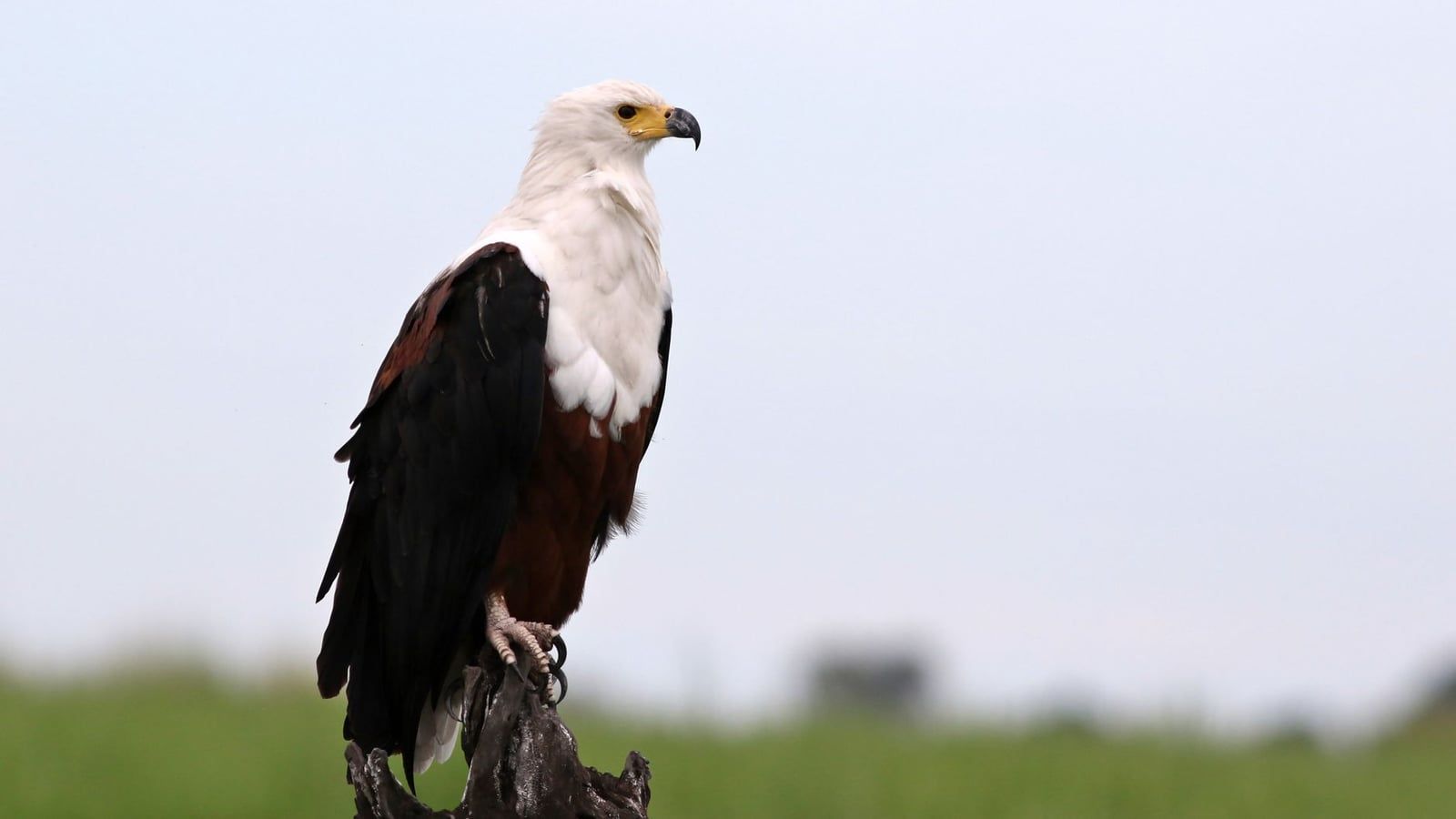
African fish eagles are the Delta's background music, one pair to every stretch of channel. Bateleurs rock overhead on their trademark unstable glide, and martial eagles work the woodland edges for gamebirds. The real prize is nocturnal: Pel's fishing owl, a ginger, monkey-faced owl that hunts fish from overhanging branches. The Xakanaxa region on the Khwai River is one of the places where this globally sought-after bird is a realistic tick.
The Specials Shortlist
Four birds justify a trip on their own. The slaty egret is a Delta speciality, feeding actively in shallow water where other herons stand still. Wattled cranes — globally threatened and Africa's tallest crane — pair off on the floodplains. African skimmers fly the open channels with their lower mandibles slicing the surface. Southern ground-hornbills boom across the woodlands in family groups. Add carmine bee-eaters, malachite kingfishers and lilac-breasted rollers in the green season and the list gets long fast.
Timing matters: migrants and breeders fill the Delta from November to April, which is prime birding season, while some heronries are actually best visited later in the year when nesting peaks. Whatever the month, the best birding platform is a mokoro or motorboat — at water level you're inside the habitat, not looking at it over a bank.
Great Migrations and the Annual Flood Pulse
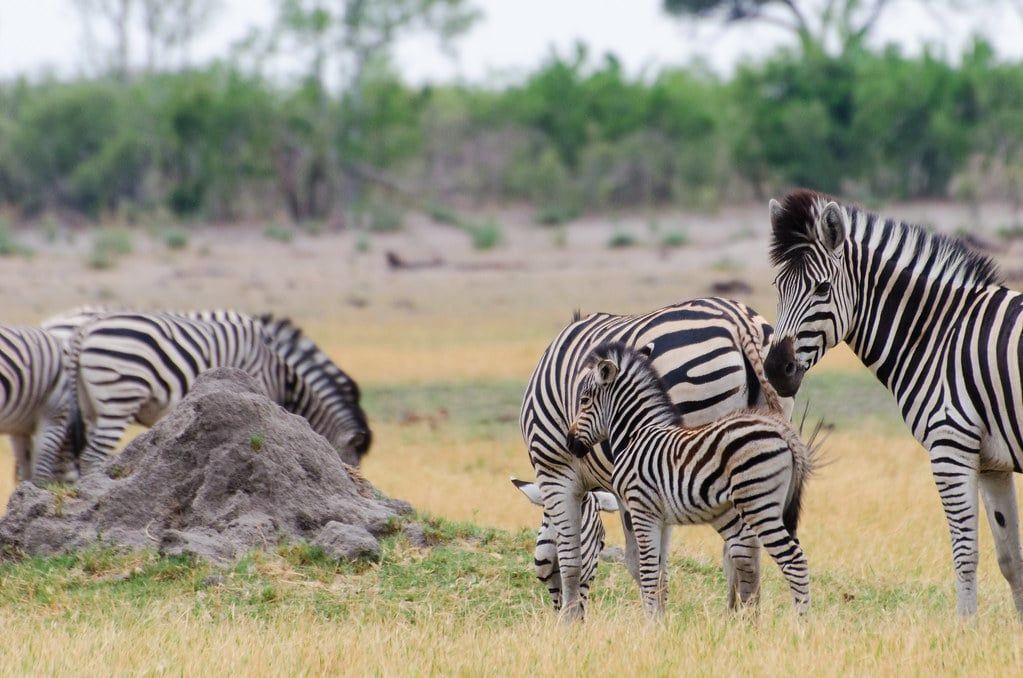
Around 25,000 Burchell's zebras migrate between the Okavango Delta and the Makgadikgadi and Nxai Pans — roughly 500 kilometres each way, which makes it the longest land migration in Africa. The herds leave the Delta with the first rains in November–December, graze the mineral-rich pans through the wet months, and return in March–April as the pans dry. Botswana's other major zebra movement, between Chobe and Nxai Pan, exceeds 1,000 km annually and resumed only after veterinary fences were removed in the 2000s. To intercept the Delta–Makgadikgadi herds in the dry months, position along the Boteti River, where camps perch above the water the zebras must reach.
Elephants run their own circuit on a shorter clock: herds cycle between the Okavango, the Linyanti, Savute and Chobe, spreading out across the region in the rains and hauling back to permanent water as the land dries. Dry-season concentrations at the Delta's core — hundreds of elephants drinking and bathing at once — are the single most reliable spectacle the region offers.
The flood pulse sets the calendar for all of it. Water arrives from Angola in April, builds to its June–August peak, and starts dropping as the local rains arrive in December. Peak water plus dry land is the sweet spot: animals compressed into the shrinking dry ground while the channels are full enough for boats. December's arrival reverses everything — game disperses outward onto fresh grazing, and the migratory birds pour in to replace it.
When to Go for Wildlife: Month by Month
July to October is the wildlife window. The flood is in, the vegetation is thinning, and every animal that spent the rains feeding outside the Delta is back at permanent water. Both activities run — game drives on dry floodplains, mokoro and boat trips on high water — and sightings per day peak. Within that window, September and October are the intense months: shrinking water pools force daily standoffs between predator and prey, and the low-angle, dust-filtered light is superb for photography. The catch is heat — October regularly exceeds 40°C, and channel water can be too low for mokoro trips in places.
November to April flips the Delta green and the value up: migratory birds arrive, the landscape flushes, and camp prices drop. Resident game stays good anywhere with permanent water. But January to March is peak rain, when downpours flood tracks, some areas become unreachable and some lodges close altogether — check conditions and confirm openings before committing. For a fuller seasonal breakdown including water levels and rates, see our guide to the best time to visit the Okavango Delta.
| Months | Best for |
|---|---|
| July–August | Peak flood water, full mokoro and boat menu, game concentrating |
| September–October | Highest game density, predator drama, top photography — hot |
| November–December | Migratory birds arriving, green scenery, lower rates, zebras moving out |
| January–March | Birding peak; rains close some areas and lodges |
| April–June | Flood arriving, quiet shoulder season, good value |
Where in the Delta to See What
The Delta is not one habitat, and area choice drives what you'll see. Match the zone to your priority species before you book — this is the decision that matters most.
Central Delta and Chief's Island
The Delta's largest landmass — the former royal hunting ground of the BaTawana — delivers its highest wildlife concentrations and predator densities, with several resident lion prides and a deserved leopard reputation around Mombo. It's also the rhino stronghold, the only area where both reintroduced species live year-round, which makes it the default choice for Big Five ambitions. Costs run high here, and the sightings justify them.
Eastern Delta and Khwai
The concessions east of the core — Chitabe, Qorokwe, and the Khwai Community Concession along Moremi's northern boundary — are predator country with strong wild dog records and mixed game throughout. Khwai adds what the reserve itself bans: night drives and guided walks with armed guides, plus mokoro trips, with vehicle numbers capped at sightings.
Western Permanent Swamps
The Jao Flats and the concessions around Jedibe are water wilderness — permanent papyrus, narrow channels, almost no dry land. Game densities are lower, but this is where sitatunga and Pel's fishing owl become realistic, and the water-based experience is the purest in the Delta. Birders and photographers should dedicate at least one camp here.
The north and the Panhandle trade density for range: year-round land-and-water viewing, the crocodile population concentrated in the Panhandle's deep channels, African skimmers working the open water, and genuinely excellent riverine birding. Moremi Game Reserve itself sits in the eastern Delta and offers all of the Big Five on public-access roads; the private concessions surrounding it permit off-road driving, night drives and walking safaris, which is precisely why their sightings run closer and longer. On where to base yourself across these zones, our Okavango Delta accommodation guide breaks down the camps by area and budget.
| Species | Sighting odds | Best months | Best area |
|---|---|---|---|
| Elephant | Abundant | June–October | Anywhere with permanent water |
| Buffalo | Common | June–October | Duba Plains, central Delta |
| Lion | Occasional | September–October | Chief's Island, Duba Plains |
| Leopard | Occasional | Year-round | Mombo, riverine forest |
| African wild dog | Occasional | June–July denning | Eastern concessions, Moremi |
| Sitatunga | Rare | Year-round in permanent swamp | Jao and Jedibe concessions |
Match the activity to the area too. Mokoro and boat trips belong in the permanent water of the west and the flood-season channels; game drives work the dry floodplains and woodland of the central and eastern Delta; guided walks, available in the concessions, trade the big sightings for the small ones — tracks, dung, insects, and the Delta at walking pace.
Frequently asked questions
Can you see the Big Five in the Okavango Delta?
Realistically, four of five. Elephant and buffalo are abundant, lion and leopard reliably present Delta-wide. Rhino were locally extinct by the early 1990s and exist only through reintroduction — white rhino from the early 2000s, black rhino from 2003, with perhaps 40 black rhino in the region — so sightings are rare to very rare. Chief's Island gives the best odds.
When is the best time to visit the Okavango Delta for wildlife?
July to October. The flood peaks June–August and the land dries simultaneously, concentrating animals at permanent water while boats and mokoros still run. September–October add the year's sharpest predator-prey action, though October regularly tops 40°C.
When is the best time for birding in the Delta?
November to April, when migratory birds arrive and resident breeders are in full activity. Resident waterbirds and the Delta's specials are findable year-round, and some heronries are actually best later in the year.
What rare animals can I best see in the Okavango Delta?
Sitatunga (best in the western permanent-swamp concessions) and red lechwe on the mammal side, plus Pel's fishing owl, slaty egret, wattled crane and African skimmer among birds. The Delta is also one of Africa's strongest African wild dog strongholds.
Which part of the Delta is best for predators?
Chief's Island and the surrounding central-Delta concessions, which hold several resident lion prides and the region's highest predator densities. The eastern concessions (Chitabe, Qorokwe) are close behind, and Duba Plains is the place for buffalo-lion interactions.
Are there rhinos in the Okavango Delta?
Yes — but only through reintroduction. The last native black rhino was poached in 1992; white rhino returned in the early 2000s and black rhino from 2003. Both live year-round on and around Chief's Island under close protection, but treat a sighting as a bonus rather than an expectation.
What is the Okavango zebra migration and when can I see it?
Around 25,000 zebras move roughly 500 km each way between the Delta and the Makgadikgadi and Nxai Pans — Africa's longest land migration. They leave with the November–December rains and return around March–April; in the dry months, the Boteti River is the place to intercept them.
Can you see wildlife in the Delta without a game drive?
Yes, and often better. Mokoro and boat trips put you at eye level with hippos, crocodiles, red lechwe and waterbirds; guided walks reveal the small creatures and tracks; and the Panhandle's crocodile and birding waters need no vehicle at all.